

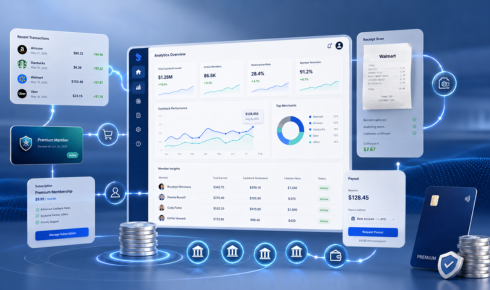
A cashback platform can appear almost effortless to the customer. Join a program, connect a bank account, make an eligible purchase and wait for money to appear. The screen may show only a merchant name, a transaction and a pending reward.
Behind that sequence sits a harder question: What must be true before the platform can say that a customer has earned money?
For Orbit Back, an early-stage cashback membership concept developed with WebMagic, the answer could not be reduced to a payment gateway or a bank-data connection. The platform had to decide whether a purchase qualified, which service provider should be credited and whether a receipt was needed. It also had to apply cashback limits, calculate provider fees and determine what funds were available for payout or withdrawal. The product’s credibility depended on those decisions being consistent and understandable.
One Platform, Three Financial Perspectives
Orbit Back was designed around a three-sided business model.
Customers needed to activate a membership, connect a bank account, make eligible purchases and understand the status of their cashback. Service providers needed to configure programs, monitor customer activity and control fees, limits, billing and withdrawals. The platform owner needed reliable transaction records and tools for cases that could not be settled automatically.
Each party sees the same purchase differently. To a customer, it is a transaction that may produce a reward. To a provider, it may create a fee and a financial obligation. To the platform operator, it is a record that must be matched, verified and reflected correctly.
This is where simple-looking loyalty products become operationally demanding. A program can attract users with a clear promise, then lose trust when pending rewards are unexplained, caps are applied inconsistently or purchases are assigned to the wrong provider.
WebMagic’s role was therefore broader than building dashboards. The team translated the concept into product rules and connected those rules to customer, provider and administrative workflows. That approach reflects the purpose of custom web development: creating software around a company’s operating model when a standard product cannot represent it accurately.

The Hard Part Was Defining When Cashback Becomes Real
A bank transaction is evidence that money moved. It is not, by itself, proof that cashback should be awarded.
A record may arrive with incomplete merchant information. It may not match the expected provider. It may still be pending or later be modified. It may exceed a cashback limit or require a receipt because the banking data is insufficient.
Plaid’s documentation illustrates why transaction-based products need state management rather than a one-time import. Its Transactions product provides fields such as date, amount, category, merchant and location. Those records can later be added, modified or removed as financial institutions process them, so Plaid uses synchronization and webhooks to keep applications updated.
Orbit Back needed product logic above that data layer. If a transaction matched a provider and met the program rules, the cashback flow could continue. If it did not, the system needed another route, such as manual provider matching or receipt verification. If a cap applied, the calculation had to reflect the remaining eligible amount.
This is the difference between connecting an API and building a financial product. The integration supplies events. The product decides what they mean.

Stripe and Plaid Were Infrastructure, Not the Business Model
Stripe supported checkout, subscriptions and payment methods. Plaid supported bank connections and transaction synchronization. Both solved important infrastructure problems, but neither could decide Orbit Back’s cashback rules.
Stripe subscriptions have their own lifecycle. A subscription may be incomplete, active, past due, unpaid, paused or canceled. Payment failures and authentication requirements can change what access a customer should receive. Stripe exposes those changes through subscription records, invoices, payment intents and webhooks.
Orbit Back still had to connect billing status to membership access. A successful checkout needed to activate the correct experience. A failed subscription required a controlled response. Provider billing also had to coexist with cashback calculations and withdrawal logic without allowing one subsystem to contradict another.
This is why complex integrations work best when they are treated as part of the operating design. Plaid could remain the source for bank transaction updates. Stripe could remain the source for subscription and payment status. Orbit Back’s own rules remained the source for eligibility, caps, provider fees and payout availability.

Designing for Exceptions
Many products are designed around the successful path: the user pays, the transaction matches and the reward is credited. Financial operations are often defined by what happens outside that path.
Orbit Back included receipt review, manual provider matching, exception handling and financial oversight. These were core functions because bank data could not resolve every purchase automatically.
An administrator reviewing an unmatched transaction needs enough context to make a defensible decision. That includes the transaction details, possible provider, membership state, applicable rules and uploaded evidence. Approving a reward without context risks financial leakage. Rejecting it without an explanation creates a support problem.
Providers need similar clarity. A charge or withdrawal should be traceable to customer activity, cashback earned, program limits and fees. Business process automation can route records and apply known rules, but it should preserve a controlled review path when the evidence is incomplete.

Product Language Became Part of Financial Control
Accurate calculation is necessary in fintech. It is not sufficient.
A customer who sees “pending” needs to know whether the platform is waiting for a bank update, a receipt review or confirmation of a program condition. A provider needs to understand what a fee represents. An administrator needs to see why automation stopped and what action is available.
The case document says WebMagic worked on product language and user experience for this reason. The interface had to explain the mechanics without exposing users to unnecessary complexity.
Clear status language reduces avoidable support requests and narrows the gap between what the system calculated and what a user believes happened.

What the Finished Platform Changed
The completed product gave the client a live, monetizable membership model rather than a set of disconnected integrations. Customers received membership activation, bank connection, purchase tracking, receipt upload and cashback visibility. Providers received program configuration, activity monitoring, billing and withdrawal tools. Administrators received financial oversight and review workflows for exceptions.
The case does not publish performance figures, so it would be misleading to claim a specific increase in retention, processing speed or revenue. Its demonstrated result is structural: the client moved from an early concept to an operating platform in which subscriptions, transaction data and cashback rules could function as one business system.
It is also a practical example of a tailored SaaS solution. WebMagic’s SaaS work emphasizes custom workflows, third-party integrations, data security and interfaces designed around operating roles. Orbit Back required each of those capabilities, with financial logic connecting them.
When Custom Development Is Justified
A custom cashback platform is not the right investment for every loyalty program. A business offering a simple discount through one merchant may be better served by an established tool.
Custom development becomes more defensible when the business model depends on rules that standard software cannot represent safely. Orbit Back combined paid membership, bank-linked purchases, provider-specific programs, cashback caps, receipt checks, fees and withdrawals. It also required separate workflows for customers, providers and administrators.
That flexibility brings responsibility. A product built around bank transactions and spending behavior must treat consent, data access and security as core constraints. It should also resist automating uncertain decisions merely to make the experience appear seamless. A visible exception queue is often safer than a confident but incorrect financial calculation.
The practical lesson from Orbit Back is that fintech engineering begins before the first API call. It begins when the business can answer four questions: When does money move? Why does it move? Who can see and act on the record? What happens when the standard flow breaks?
Once those answers are explicit, Stripe and Plaid can do what they do well. Without them, even excellent integrations can process transactions without fully understanding the promise the product has made.