

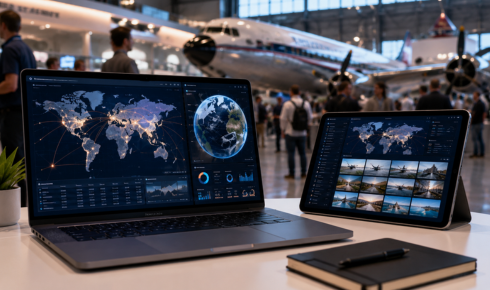
AV-Con 2026 was not a generic software expo. Held on April 4, 2026, at the Delta Flight Museum in Atlanta, the event brought together aviation creators, enthusiasts, vendors, and guest speakers for a full day of panels, meet-and-greets, museum access, and community activities.
This context makes LogMy.World’s appearance more relevant than a simple event mention. Dr. Axel Schauenburg and Benedikt Escher represented the LogMy.World team and presented the platform at AV-Con 2026.

The Product Problem Behind Flight Logging
The product problem behind that appearance is easy to describe and difficult to solve well. A flight log sounds simple until it becomes real. Serious travelers and aviation enthusiasts rarely keep their history in one clean place. Their records tend to spread across spreadsheets, older services, exported files, booking emails, photos, and memory. Over time, that history becomes harder to search, harder to compare, and harder to trust. What began as personal record-keeping turns into fragmented infrastructure that no longer feels like one complete record.
WebMagic’s case study frames the challenge in similar terms. The product owner wanted a structured web platform where users could log flights, manage travel history, import old records, and explore aviation statistics without relying on disconnected tools or static spreadsheets. The same case study says the platform had to handle routes, airports, airlines, aircraft details, dates, times, media, custom fields, profile settings, premium access, and community interaction while still remaining usable for both general travelers and detail-heavy aviation users. That is a much more specific assignment than simply building a travel app.

A Product Built by Aviation Insiders
The strongest part of the story is where the idea came from. On its official About page, LogMy.World says it was built by aviation enthusiasts for aviation enthusiasts and by two airline-industry insiders who had each logged more than two thousand flights. The same page says they stored their own records in spreadsheets and apps, found existing flight-log tools insufficient, started building in 2020, and launched a beta in the third quarter of 2021 after testing with fellow flyers. Benedikt Escher adds similar context in a public Travel Massive post, saying he and Axel had both flown far more than one thousand flights and wanted to combine simplicity with a high degree of customizability.
The official product pages make the platform’s response to that friction unusually clear. Users can start a new log, upload an Excel file, or import records from providers such as FlightMemory.com, MyFlightradar24, App in the Air, and OpenFlights. The homepage describes three core outcomes in very plain language: keep track of flights, visualize and browse travel memories, and share statistics and memories. The About page adds that flights can be entered manually, imported by file, or automated through an API as a Premium feature. Taken together, those pages describe one product that combines logging, migration, visualization, analysis, and social presentation in one place.

Why Custom Development Mattered
This is where custom development begins to matter. WebMagic’s case study says the team built structured models for flights, routes, airports, airlines, aircraft, dates, times, media, and custom fields. It also built import workflows for historical data from external services, templates, and personal files, including field matching, validation, and post-import notifications. To support analysis and visualization, the platform included interactive map and globe views, route visualization, statistics, rankings, summary views, subscription-based access logic, payment flows, messaging, following, sharing, and administrative tools. In plain terms, the work of custom development here was to turn messy real-world behavior into product architecture.
In this case, what looked from the outside like a flight diary was actually a product with legacy-data migration, multiple import paths, profile features, visual exploration, analytics, and paid functionality. That distinction matters. The complexity was already in the workflow; the build simply absorbed it. Instead of asking users to keep stitching together spreadsheets, exports, and memory by hand, the platform gave them one structured place to keep, analyze, and share that record.
The public product updates suggest that the team kept improving along those lines rather than drifting into feature noise. In a public LinkedIn review of 2023, Axel Schauenburg said LogMy.World grew its user base by 40 percent year over year, nearly doubled revenue, added a 3D globe view and a more user-friendly main statistics page, and improved sign-up, upgrade, import, search, and loading speed. In a later Travel Massive comment, Benedikt Escher said 2024 focused on improving page speed, fixing bugs, refining imports from other providers and private Excel files, and reacting quickly to the shutdown of App in the Air by building an import process for its export files. That pattern suggests a team staying close to the core workflow rather than chasing novelty.

Why AV-Con Was a Strong Product Fit
AV-Con’s own pages help explain why showing up there mattered. The event describes itself as a convention built for aviation fans by aviation creators. The FAQ says it was organized by Travgeeks, a boutique brand agency founded by aviation content creators. The Get Involved page says creators were invited to connect with fans face-to-face and vendors were offered table space in the main hangar, steps away from creators and attendees. The event blog frames AV-Con as a place where fans and creators finally meet face-to-face. The current home page adds that the success of the 2026 edition led to an expanded three-day event in Orlando in 2027.
That kind of room tests a niche product in a way a generic conference cannot. Aviation enthusiasts know immediately whether imports matter or whether they are only a checkbox. They know whether route visualization is useful or cosmetic. They know whether statistics reflect real aviation behavior or generic dashboard thinking borrowed from another category. In that sense, LogMy.World’s AV-Con presence matters even if some details remain unspecified in public event materials. It placed the product in front of a concentrated aviation community that could judge not only whether the platform looked polished, but whether it genuinely understood the problem it claimed to solve.
The Broader Software Lesson
The narrow lesson here is about flight logging, but the broader one is about software strategy. When users already live across spreadsheets, exports, disconnected tools, and manual workarounds, the answer is rarely just a cleaner interface. The answer is usually a system that respects old data, lowers migration pain, makes history visible, and creates a reason to return. That is the pattern visible in LogMy.World’s feature set and in WebMagic’s explanation of the build.
Seen that way, the AV-Con appearance becomes more than a community update. It becomes a compact business case for building around the real operating habit first, then building the product that can carry it. That is also the clearest CTA: if your product still depends on scattered records and manual workarounds, start by redesigning the workflow, not just the interface.