

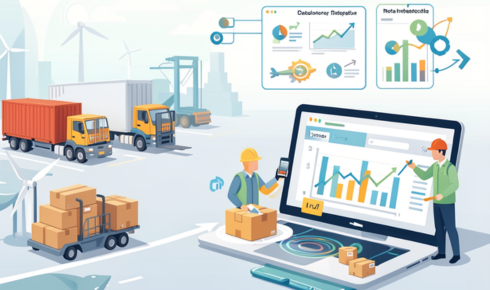
A New Morning at the Warehouse
John Martinez used to start his day wading through a swamp of spreadsheets and email threads. As an operations manager at a mid-sized third-party logistics (3PL) provider, his job was a daily relay race of copying order data from an e-commerce system into warehouse pick lists, emailing trucking partners about pickups, and calling team members to double-check inventory. “We were juggling data in five different places,” he recalls.
By the time a spreadsheet landed in someone’s inbox, the information was already out of date. The result was often delays: trucks left half-empty because an email update came too late, or orders sat idle because a phone call was missed. Today, Martinez’s mornings look very different. His company adopted an integrated logistics platform that links delivery, warehouse and order management in real time – and their average delivery times have dropped by roughly 25%. In an industry where shaving even a few hours off a shipment cycle can be a competitive edge, that improvement is game-changing.

The High Cost of Siloed Logistics
Martinez’s experience is far from unique. Across the U.S., logistics and e-commerce professionals have long relied on ad-hoc tools – Excel spreadsheets, email updates, even fax and phone calls – to bridge gaps between disconnected systems. It’s a band-aid approach that quietly introduces errors and lags. Nearly 88% of spreadsheets contain errors, according to industry research. Every time data gets re-typed or forwarded manually, there’s another chance for a mistake or a missed update. These manual workarounds also sap productivity: a 2023 study found staff devote about 22% of their time to manual data juggling like reformatting files or hunting through email attachments.
“We had one employee whose entire job was reconciling spreadsheets from sales and warehouse teams,” Martinez says of the old days. All that time spent fixing formulas or chasing the latest figures is time not spent moving goods. In effect, disconnected systems turn supply chain management into constant firefighting, with teams reacting to yesterday’s information instead of today’s events. The pain points range from small headaches to large hits on the bottom line. Minor data discrepancies – a missed inventory update here, a duplicate order entry there – can snowball into bigger issues like stockouts or late deliveries, requiring expensive expedites to fix. And in an era when customers expect lightning-fast, trackable shipping, these delays carry steep costs.
Studies show supply chain disruptions and slow responses cost organizations billions annually. For 3PLs whose business is on-time service, the stakes are especially high. A single missed email could mean a truck route goes unoptimized or a customer doesn’t get that “out for delivery” notification—little slip-ups that erode trust. The message from logistics teams is clear: the spreadsheet-and-email approach is breaking under the strain of modern demand.

One Platform, Complete Visibility – The Integration Advantage
The rising solution is unified logistics software that synchronizes core supply chain modules — from order intake and inventory to warehouse ops and delivery — in real time. Instead of disconnected systems, everything updates automatically. A new order triggers inventory checks, warehouse picking, and carrier booking — instantly and without manual intervention.
Integrated 3PL platforms combine order management (OMS), warehouse systems (WMS), delivery tracking, and analytics into a single dashboard, giving logistics teams full visibility. “It’s like seeing the whole puzzle, not just one piece,” notes analyst Priya Desai.
In practice, integration means:
- No duplicate data entry: Orders flow directly from e-commerce systems into warehouse and shipping modules, reducing errors and replacing spreadsheet chaos.
- Real-time tracking: Inventory and delivery status update automatically, enabling faster decisions and better customer visibility.
- Automated alerts: Low stock triggers restocks; late shipments prompt instant notifications — without inbox delays.
These changes drive measurable results. One mid-sized brand cut its fulfillment cycle by 25% by adopting real-time inventory tracking. Broader studies show integration can boost efficiency by 20–50% and improve on-time rates, reduce stockouts, and ease team workload.
But it’s not just about speed. Unified data lets managers identify patterns, forecast more accurately, and reallocate stock across warehouses. When disruptions hit — like weather or port delays — the system reroutes and notifies stakeholders within hours. As Desai puts it, “Integration turns blind spots into control towers.”

From Firefighting to Efficiency: A Day Transformed
To see the human impact of integration, consider a day in the life of logistics coordinator Mike Caldwell.
Before, his day began with crisis management: chasing missed pick lists, sorting through 50+ emails, decoding spreadsheet versions from clients, and fielding driver complaints about wrong addresses. By noon, most of his time had gone to tracking down updates rather than moving freight. “It felt like running in circles,” he says.
After integration, Mike logs into a unified platform that shows 98% of orders picked and en route, with live vehicle tracking and automated alerts. Orders flow directly from clients into the system, inventory levels trigger auto-replenishments, and delays prompt real-time rerouting — all without email threads or phone calls. His focus has shifted to onboarding clients and performance analysis. “It’s a night-and-day difference,” he says.
The benefits go beyond efficiency. Emergency calls have dropped. Stress levels and burnout are down. One client even stopped sending 5 a.m. status checks — now they just check the portal. For Caldwell’s team, integration replaced daily friction with transparency and trust, and it shows in both morale and customer loyalty.
A Broader Shift in Logistics (No Magic, Just Integration)
The shift toward integrated platforms reflects a larger trend: eliminating friction in logistics. As analyst Priya Desai notes, “You can’t compete on speed and cost if your internal systems are fighting each other.” This realization is driving rapid investment in logistics tech, with the market for digital solutions expected to triple from $38 billion in 2025 to over $120 billion by 2032. Integration is central to this growth — not for show, but to reduce delays, errors, and costs.
Still, integration isn’t plug-and-play. It requires upfront planning, training, and technical alignment — like linking modern platforms with older warehouse systems. Caldwell’s team, for example, spent weeks connecting a legacy inventory database. But most companies see returns within months. In contrast, clinging to manual processes builds “technical debt” — hidden inefficiencies that escalate over time. “The cost of doing nothing is starting to outweigh the cost of doing something new,” Desai says.
Big picture, integrated 3PL platforms are reshaping logistics the way cloud computing reshaped IT. Tools once reserved for giants are now available to smaller firms. A growing field of tech providers — including WebMagic — offer platforms that unify every step, from order to last-mile delivery, with real-time automation and API-driven dashboards replacing spreadsheets and email.
For logistics leaders, the message is clear: the tools to boost speed, accuracy, and transparency are here. While the transition takes effort, the industry is moving toward a more connected, collaborative model — and the age of email overload may finally be ending.