

In a busy distribution centre, “downtime” is not a tidy line item. It is a queue of orders that cannot be despatched, a printer that will not produce labels, a customer service team watching promised delivery dates slip.
The uncomfortable part is that integration upgrades often fail in precisely those moments when the operation is least able to absorb surprises: end-of-day collection, peak season, a marketplace promotion, a new carrier cutover. Industry research underlines why leaders treat these changes as high-stakes. Uptime Institute has found that outage costs can be severe, with a 2022 survey showing a quarter of respondents reporting their most recent outage cost more than $1 million, and another 45% reporting $100,000 to $1 million.
Information Technology Intelligence Consulting similarly reports that more than 90% of mid-size and large enterprises place the cost of an hour of downtime above $300,000.
Good journalism requires restraint about numbers like these. Uptime’s own guidance is to treat outage data sceptically because reporting is commercially sensitive and uncertain.
But even with that caveat, the direction of travel is clear: the more your operation depends on digital connections, the more painful it is when those connections break.
Context and backstory
Most logistics and supply-chain organisations do not rely on a single system. They operate through agreements between systems: an ERP sends orders to a WMS, a TMS books carriers, visibility platforms consume tracking events, and marketplaces require rapid updates. The data flows are diverse.
EDI still moves core documents between trading partners, including purchase orders, invoices and shipping notices. In the United States, X12 maintains widely used transaction sets for industries such as transportation and supply chain. Globally, UN/EDIFACT defines international standards for the electronic exchange of structured business data.
Alongside EDI, many supply chains now depend on event-based integrations. The GS1 EPCIS standard, for example, enables partners to share event data describing “what, where, when and why” about the movement and status of products. This model is increasingly used in traceability and supply-chain visibility initiatives.
These integrations matter because they function as operational contracts with partners, not just internal software. A broken mapping can mean a missed pickup. A duplicated message can create a duplicate shipment. Even a small schema change can cascade into finance, compliance and customer service systems.
Upgrade pressure continues to grow as platforms formalise change through versioning and deprecation schedules. Shopify, for example, releases a new stable Admin API version every three months and supports each version for at least 12 months. Amazon publishes similar deprecation schedules for its Selling Partner API, where removed resources stop functioning after their retirement date.
For logistics leaders, this means upgrades are unavoidable. The real challenge is not whether systems will change, but how to introduce those changes safely—moving from old to new without stopping operations, and being able to reverse course when real-world conditions expose issues that testing did not reveal.

The mechanics of a safe rollout
The main mistake in integration upgrades is treating them as a single switch. A safer approach is controlled migration with a limited blast radius. Engineering practice generally relies on three principles: run old and new systems in parallel, shift traffic gradually and monitor differences closely enough to know when to stop. In practice, many companies discover that their integration architecture was never designed for controlled rollout. Legacy connections, rigid EDI mappings and tightly coupled APIs make gradual migration difficult.
This is why companies often work with integration specialists such as WebMagic, who design systems where rollout and rollback are part of the architecture rather than emergency procedures.
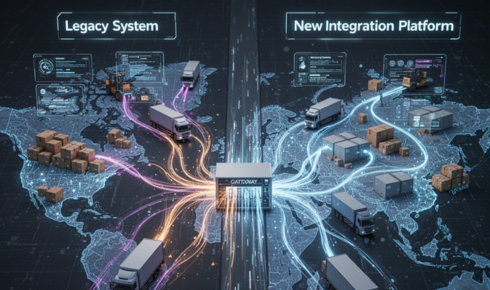
One common model is the Strangler Fig pattern, described in Microsoft’s architecture guidance. A façade or proxy intercepts requests and routes most traffic to the legacy system at first. Portions are then gradually shifted to the new system while clients continue using the same interface.
For supply-chain teams, “traffic” is not only web requests. It can mean orders by warehouse, shipments by carrier or EDI messages by trading partner. The façade might be an API gateway, routing logic in an integration platform or a queue consumer deciding which message processor to use.
Progressive rollout methods share the same goal: expose a small portion of real operations to the new system, learn quickly and expand only when signals remain stable. The Google SRE workbook describes canary releases as a way to reduce deployment risk by testing changes on a small share of traffic. If only 5% of shipments pass through a new carrier-label service, potential damage remains contained while teams validate data mapping, rate limits and operational edge cases.
Another approach is blue-green deployment, where two environments run simultaneously and routing switches between them. This model can avoid downtime and make rollback as simple as reverting a routing change, though it often requires additional infrastructure.
For logistics organisations, rollout segmentation should match real operations. Deploying “by warehouse” is often safer than “by customer” because it aligns with process differences and carrier setups. Batch processes also need attention: EDI upgrades often occur by trading partner or document type rather than a percentage of total traffic.
Safe rollout also requires the ability to stop quickly. Google’s SRE guidance discourages all-at-once deployments and emphasizes gradual releases with clear rollback paths. In integration environments, this means having a practical kill switch—a routing rule, feature flag or queue pause that allows teams to halt the rollout before issues spread across the system.

Rollback that works in the real world
Many organisations discover too late that rollback is not a button. For integrations, rollback is a system property you design—especially around data.
Google’s reliability guidance stresses that rollbacks are normal and should be practised. Teams are encouraged to test them regularly to uncover issues such as version incompatibilities or broken automation. For schema changes, Google recommends releasing an intermediate version that supports the new structure before deploying features that depend on it.
This principle is known as the expand-and-contract pattern, or parallel change. As described by Martin Fowler, the approach involves three phases—expand, migrate and contract—to safely implement backward-incompatible changes. Integration upgrades often fit this model because they involve published interfaces used by partners, marketplaces or EDI systems.
For logistics operations, the risks are practical. A rollback will not unsend an EDI message already processed by a partner. It will not remove a shipping label already attached to a parcel. And it will not automatically resolve duplicates created by retry attempts. That is why rollback planning must include business reconciliation, not only technical reversal.
Two technical controls reduce these risks. The first is idempotency, which ensures retries do not create duplicate side effects. Payment platforms such as Stripe document the use of idempotency keys to safely retry requests without executing the same action twice. In logistics integrations, the same principle applies to operations such as creating shipments, booking pickups or confirming dispatch.
The second control is resilient failure handling. Microsoft’s Azure architecture guidance warns that poorly coordinated retry logic can overload downstream systems. The Retry Storm antipattern shows how uncontrolled retries during outages can escalate into cascading failures. Limiting retries, using backoff delays and implementing circuit breakers helps prevent this.
Rollback safety also depends on observability. The Google SRE workbook notes that production environments inevitably expose defects that testing misses. Canary releases reduce risk by introducing changes to a small portion of traffic, but they require metrics that clearly compare new and existing paths.
In practice, this means being able to trace an order across systems—from marketplace webhook to warehouse update to carrier booking. Distributed tracing standards such as OpenTelemetry enable this by linking events across services.
For operations leaders, the key question is straightforward: when something fails, can the team quickly determine whether the issue originates in the new integration or elsewhere in the system?

From Risky Deployments to Controlled Releases: Rethinking Integration Upgrades in Supply Chains
Integration upgrades are often seen as a technical task. In supply chains, they are closer to operational change management supported by software.
Organizations that upgrade systems safely tend to follow one principle: every release must be reversible, and the stop mechanism must work faster than the damage. Research from Uptime Institute shows that many large outages originate from configuration errors and poorly managed changes rather than hardware failures. Reliable upgrades depend on clear runbooks, disciplined change control and rehearsed procedures.
A practical approach is to treat integration upgrades as controlled experiments. Run old and new integrations in parallel, gradually increase exposure and monitor the system to distinguish test traffic from normal operations. Data changes should also support rollback through techniques such as expand-and-contract schema updates to avoid incompatible versions.
Because integrations constantly evolve through new APIs and platforms, companies benefit from predictable upgrade cycles. Regular releases reduce risk and make change routine rather than disruptive.
In practice, “no downtime” is less a promise than a discipline: limit the blast radius of changes, increase visibility and ensure systems can quickly return to a stable state.
Experienced integration partners help design this architecture from the start. Companies such as WebMagic focus on building systems where rollout and rollback are part of the infrastructure, allowing businesses to continue operating while technology evolves.