

When security first looks like an operations glitch
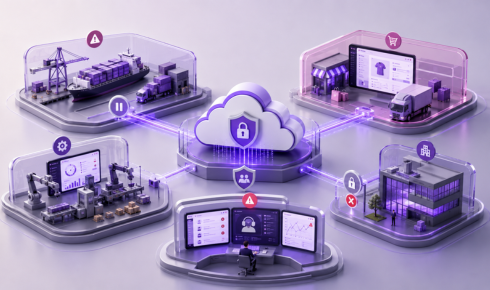
The first sign of a multi-tenant SaaS security failure rarely looks dramatic. A shipment dashboard starts showing inconsistent data. An order record appears where it should not. A partner integration begins pulling more information than anyone expected.
At first, it may look like a routine operations issue. Support opens a ticket. Engineering checks the logs. A logistics manager waits for an explanation while customers ask why a shipment status no longer matches the carrier update.
By the time security teams recognize the pattern, the cost may already be spreading. Service credits, legal review, customer churn and manual workarounds can begin before anyone uses the word breach.
IBM reported that the global average cost of a data breach reached $4.88 million in 2024 and remained about $4.44 million in 2025. The average breach still took 241 days to identify and contain. Credential-related breaches remained among the most common initial attack paths and could take up to 186 days just to identify, according to IBM.
That matters sharply in supply-chain software because these systems do not sit at the edge of the business. They are the business. Verizon’s 2026 manufacturing snapshot found that ransomware accounted for 61 percent of breaches in the sector. Third parties were involved in 61 percent. The leading initial access vectors were vulnerability exploitation at 38 percent, phishing at 13 percent and credential abuse at 11 percent.
Verizon also pointed to the ransomware attack on Asahi Group Holdings, which led to shutdowns at domestic manufacturing facilities and suspended shipments. The example is a useful reminder: breach costs rarely stay inside security budgets. They move into delivery schedules, customer promises and revenue operations.

Why shared architecture fails expensively
Multi-tenant SaaS is not inherently insecure. It is the standard architecture behind much of modern software because shared infrastructure lowers costs, simplifies operations and allows providers to scale faster.
But the same model that makes SaaS efficient also raises the cost of mistakes. NIST describes SaaS as a typical multi-tenant model in which multiple users access applications while their data may reside in the same location. The agency also warns that application vulnerabilities can expose one user’s data to others.
OWASP’s multi-tenant guidance frames the risk directly: a single vulnerability can expose data across tenants, while misconfigurations and resource contention can cross tenant boundaries.
The most expensive misunderstanding is the belief that authentication alone equals isolation. AWS’s tenant-isolation guidance makes a clear distinction between the two. A user can be authenticated and authorized and still access another tenant’s resources if tenant context is not enforced separately and consistently.
In one AWS white paper, the point is stated simply: “Isolation is not optional.”
For a SaaS platform, the practical meaning is straightforward. Once a request enters the system, every downstream service, database, cache, queue and log pipeline must still know which tenant the request belongs to. Each layer must reject anything outside that boundary.
If that context is lost, the architecture may still look secure on paper. In practice, it becomes fragile.

The mistakes that keep repeating
The first recurring mistake is trusting the client too much.
OWASP’s API Security Top 10 lists broken object-level authorization as a leading risk because attackers can manipulate object IDs in paths, queries, headers or request bodies to retrieve data they should not see.
In a multi-tenant SaaS platform, that risk grows when the application trusts client-supplied tenant IDs or fails to bind tenant context tightly to the authenticated session. OWASP recommends establishing tenant context early, validating tenant IDs and propagating tenant context securely across every layer.
AWS also recommends centralizing authorization logic and using tenant-specific policy stores where needed. The business reason is simple: critical access decisions should not be rewritten at every endpoint. Each shortcut creates another place where access can quietly widen.
The second mistake is leaving human access controls optional and machine access controls poorly governed.
CISA says multifactor authentication reduces risk because a stolen password alone is no longer enough. The 2024 Snowflake intrusions showed why this matters. Mandiant said every incident it responded to traced back to compromised customer credentials, not a breach of Snowflake’s enterprise environment.
Snowflake responded by adding account-level MFA policies, expanding compliance monitoring and saying it would require MFA for all human users in newly created accounts.
The same lesson applies to support and admin tooling. Okta said that in its 2023 support-system incident, a threat actor accessed files associated with 134 customers. Some files included session tokens that could enable session hijacking.
For SaaS vendors, the expensive mistake is not only weak customer-facing identity. Support portals, admin consoles and diagnostic artifacts are also part of the production attack surface.
A third mistake is giving integrations and nonhuman identities more power than they need.
Google’s threat intelligence team said a 2025 campaign targeting Salesforce customers used compromised OAuth tokens associated with Salesloft Drift. Attackers exported data and searched it for AWS keys, passwords and Snowflake-related tokens. Google advised customers to review integrations, revoke and rotate credentials and investigate downstream systems.
The broader lesson is least privilege. Google says apps should request only the access they need. Microsoft’s Entra guidance recommends stronger credential patterns, monitoring service-principal sign-ins and granting only minimal permissions.
In a logistics stack with ERP, TMS, WMS, marketplace, CRM and carrier integrations, overbroad scopes are not convenience. They are latent blast radius.
The fourth mistake is treating cache design, audit trails and offboarding as housekeeping.
In multi-tenant systems, these are security controls. OWASP recommends tenant-specific cache keys, tenant-isolated audit trails, monitoring cross-tenant access attempts, complete data deletion during offboarding and clear provisioning logs.
AWS’s SaaS Lens also recommends injecting tenant context into logs and metric events through shared layers.
That matters because many failures are discovered too slowly. Verizon’s 2026 manufacturing snapshot found that only 23 percent of third-party organizations fully remediated missing or improperly secured MFA on cloud accounts. Weak passwords and permission misconfigurations took almost eight months to resolve for half of findings.
The money leak is often not the original flaw. It is the delay.

Why supply-chain businesses feel the damage faster
For logistics and commerce leaders, the business consequence is immediate.
When a platform manages freight visibility, warehouse execution, order orchestration or carrier communication, a security breakdown quickly becomes an operations problem. A misrouted export can expose customer records. A compromised service account can interrupt carrier communication. A weak offboarding process can leave access open after a vendor relationship has ended.
Verizon’s manufacturing data shows the prevalence of third-party involvement and the real-world potential for suspended shipments and downstream disruption. AWS, meanwhile, notes that tenant identity must be treated as a first-class construct in multi-tenant architecture.
Together, those points lead to a practical conclusion. The more software intermediaries a supply chain depends on, the more important it becomes to prove exactly which tenant, service account, API client or integration touched which record and why.
That is why the old move-fast logic increasingly looks expensive.
CISA’s secure-by-design guidance argues that the most important security controls should be enabled by default, rather than left for customers to discover and configure later. In multi-tenant SaaS, that means mandatory MFA for human administrators, hardened defaults for support tooling, narrow OAuth scopes, certificate-based or managed identity patterns for machine access, centralized tenant-aware authorization and durable audit trails that preserve tenant context from the first request to the last export.
These controls can feel heavy during product development. They are lighter than a breach.
The safer pattern now emerging
The providers getting multi-tenant SaaS security right are converging on the same pattern.
They separate isolation from simple login logic. They make secure defaults harder to bypass. They treat machine identities as security subjects, not implementation details. They centralize authorization so a single rushed change cannot quietly widen access at an API edge. They design observability so tenant context follows every meaningful action through the system.
AWS explicitly recommends reducing developer dependence on bespoke isolation code. OWASP’s guidance now reads less like theory and more like a record of preventable mistakes.
The real test of multi-tenant SaaS security is not whether customers share infrastructure. That question was settled years ago. The test is whether the provider can prove boundaries under stress: during onboarding, during a support escalation, during token compromise, during a noisy-neighbor event, during offboarding and during the long middle months when no one thinks anything is wrong.
Companies will still spend on security. The difference is where the money goes.
Mature SaaS teams spend before the incident: on tenant-aware authorization, access hygiene, integration reviews and audit trails that make risk visible. The alternative is to spend later on breach response, downtime, customer distrust and operational cleanup.
The cheapest control is usually the one added before the first customer asks why another customer’s data appeared on their screen.